Curriculum
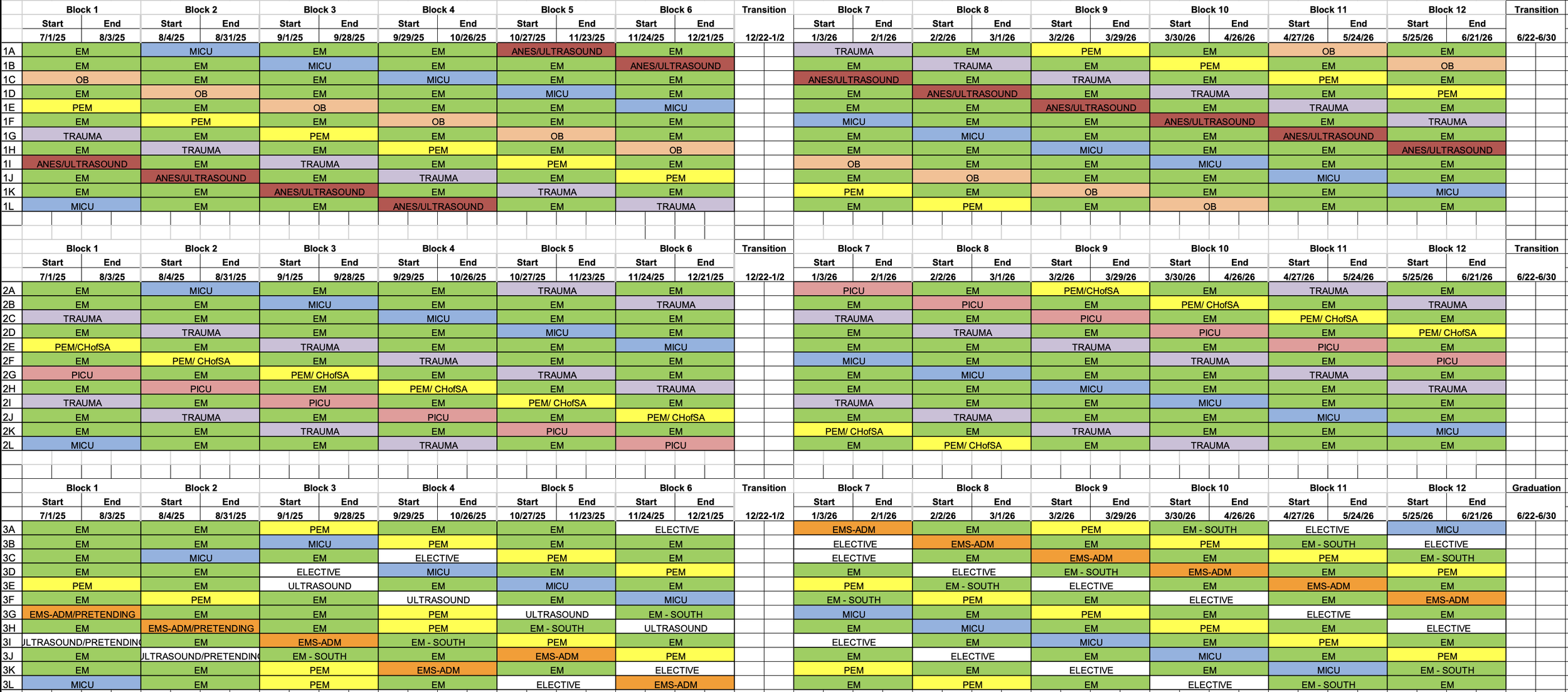
The emergency medicine residency curriculum is based on twelve, 4-week blocks during each post-graduate year. The curriculum is designed to provide residents with the necessary skills and knowledge to practice effectively in any Emergency Department.
The PGY1 year is designed to give incoming residents a broad knowledge base and a foundation in core Emergency Medicine principles and clinical skills.
In the PGY2 year, residents assume more leadership and patient care responsibility. This is achieved through an increased number of Critical Care and Emergency Medicine months. Residents are also encouraged to develop more advanced procedural skills and to learn to manage multiple high acuity patients.
PGY3 residents take an active role in overseeing the Emergency Department flow as well as supervising PGY1 and 2 residents. They also lead weekly case conference and provide simulation/procedural lab instruction to rotating medical students. Senior residents explore their personal interests during two months of electives. This includes rotations in global health, wilderness medicine, ultrasound, EMS, toxicology and a wide variety of EM related topics.
PGY1 Year
Emergency Medicine, 23 weeks
Pediatric Emergency Medicine, 4 weeks (Driscoll Children’s Hospital)
Trauma, 4 weeks
Medical ICU, 4 weeks
OB / GYN, 4 weeks
Anesthesia / Ultrasound, 4 weeks
PGY2 Year
Emergency Medicine, 28 weeks
Trauma, 8 weeks
Medical ICU, 4 weeks
Pediatric Emergency Medicine, 4 weeks (CHRISTUS Children’s in San Antonio)
Pediatric ICU, 4 weeks (Driscoll Children’s Hospital)
PGY3 Year
Emergency Medicine, 24 weeks
Pediatric Emergency Medicine, 8 weeks (Driscoll or CHRISTUS Children’s)
Elective, 8 weeks
Medical ICU, 4 weeks
EMS / ED Administration / Medical Student Teaching, 4 weeks
Please see below for a sample academic schedule.